

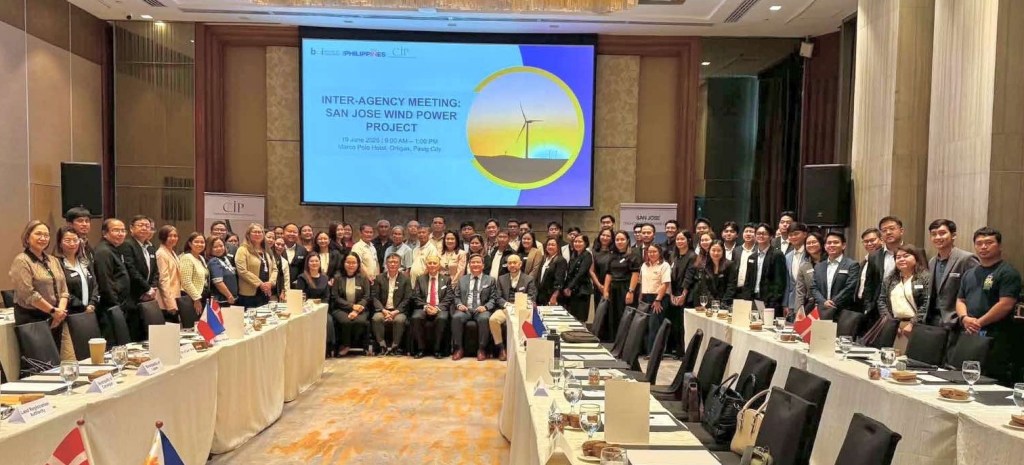
PASIG CITY — More than 75 participants from 30 national government agencies, local government units, and the Copenhagen Infrastructure Partners (CIP) discussed permitting and regulatory requirements for the proposed 300-megawatt San Jose Wind Power Project (WPP) in Nueva Ecija.
The Board of Investments (BOI), through its One-Stop Action Center for Strategic Investments (OSAC-SI), convened the interagency meeting on June 19 here to strengthen coordination among stakeholders on project implementation.
The CIP, a global fund manager and leading investor in energy infrastructure based in Denmark, proposes to develop the San Jose WPP that will cover a massive 4,617 hectares across San Jose City and the towns of Lupao and Carranglan, as well as part of the Talavera watershed forest.
Costing some P30.5-billion (approximately $520 million), the project is expected to contribute to the country’s renewable energy targets, as well as generate employment during construction, stimulate local economic activity, and create long-term opportunities for host communities.
In the meeting, BOI Investments Assistance Service Director Ernesto Delos Reyes, Jr. underscored the role of Executive Order No. 18, which constituted “Green Lanes” for strategic investments while ensuring compliance with regulatory and environmental requirements.
“Renewable energy is now a strategic imperative,” said Delos Reyes. “Our mandate is clear—to translate policy into projects, and projects into jobs for every Juan.”
Representatives from the BOI and the Anti-Red Tape Authority (ARTA) also presented initiatives to streamline permitting processes under the Green Lane framework, while CIP provided updates on the project’s ongoing feasibility studies, stakeholder engagement, and permitting activities.
In a recorded message, Przemyslaw Apoloniusz Lupa, CIP head for Asia-Pacific, highlighted the Philippines’ strong potential for renewable energy investments.
“The San Jose Wind Power Project reflects the growing confidence of global investors in the Philippines’ renewable energy sector,” Lupa said. “We believe the country has a strong opportunity to become a regional leader in clean energy development, supported by clear policy direction, strong local partnerships, and proactive government collaboration.”
Ambassador of Denmark to the Philippines Franz-Michael S. Mellbin, meanwhile, underscored the growing partnership between Denmark and the Philippines in advancing sustainable energy, but noted that project impacts must be managed and balanced through close stakeholder engagement.
“Working together, we can make CIP’s project a success for all while providing the sustainable, affordable and reliable energy that Filipinos need and deserve,” Mellbin said.
The meeting concluded with discussions on key permitting requirements and next steps to support the timely development of the project.
Participants also signed a Manifestation of Support for Renewable Energy Transition and Environmental Stewardship, reaffirming their shared commitment to advancing clean energy development, strengthening energy security, and promoting responsible environmental stewardship.
Atty. Teodulo San Juan of CIP said the strong participation of government partners demonstrates the value of early and proactive coordination in advancing strategic renewable energy projects.
“We remain committed to transparency, regulatory compliance, and meaningful stakeholder engagement as we work toward realizing the San Jose Wind Power Project and its long-term benefits for host communities and the country’s clean energy transition,” San Juan added.
CIP, which invests in solar and wind power generation, energy storage, transmission and distribution, advanced bioenergy, low-carbon fuels and carbon capture, currently has projects in more than 30 countries. It aims to start construction for the San Jose WPP by April 2027 and reach commercial operations by 2029. ▲
COVER PHOTO: File photo of CIP wind project in Karnataka, India




Leave a Reply