
By HENRY EMPEÑO | August 31, 2025
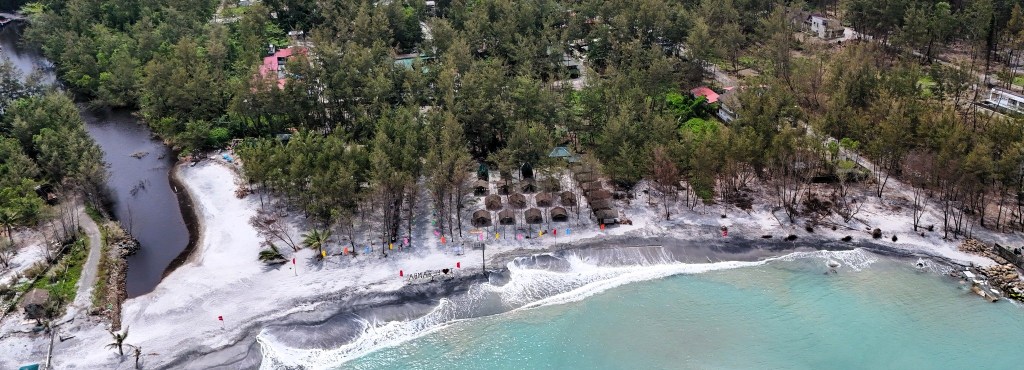
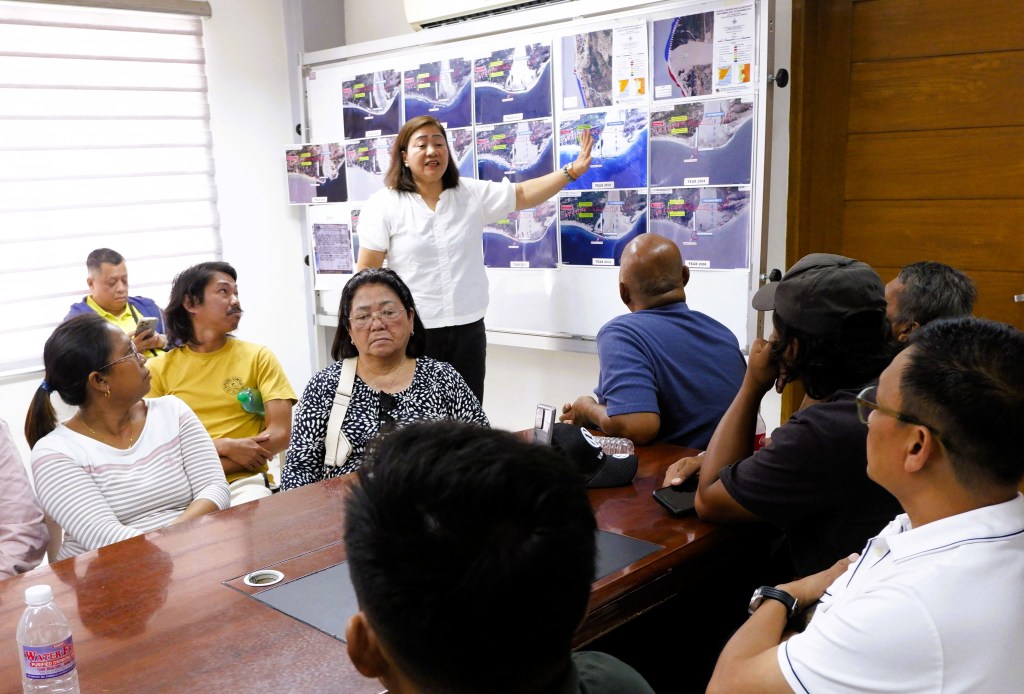
IBA, Zambales — Gov. Hermogenes E. Ebdane Jr., along with officials of concerned local government units and national agencies, met with beach resort owners to thresh out issues and find solutions to the problem of coastal erosion at Sitio Liwliwa, a popular seaside destination in San Felipe town.
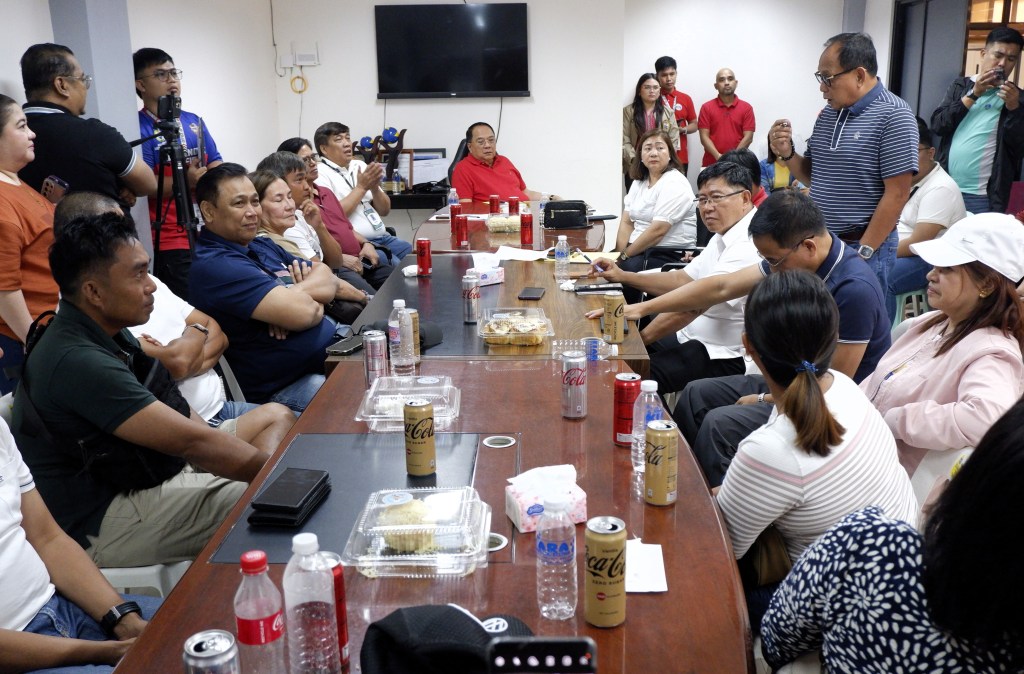
The dialogue took place on Aug. 26 at the Provincial Engineering Office during an inter-agency committee (IAC) meeting on foreshore land development and management.
The resort owners and representatives present in the forum were: Elezer and Mariam Requirme of Zamba Villas by the Bay, Erwin and Flerida Cruz (Zambali Shore), Rodolfo Manaog (PAMS Beach Villas), John Olaso (Le Quvoh Beachfront Resort), Mark Limson (LSU Resort), Roberto Pael (Weng Resort), Justo Ceasar Siscon (Promised Land Beach Resort), Editha Bugarin (Jhen Beach Resort), Jacy Jimenez (Enzo’s Hideaway Resort), and Sherryl Ann Cometa (Kairi’s Place Resort).
San Felipe Mayor Reinhardt Jeresano, together with barangay captains Marlita Santos of San Rafael, Alfred Abille of Sto. Niño, and Glenn Peñarubia of Manglicmot, as well as some lot owners along coastal areas joined the meeting.
Gov. Ebdane made it clear to all present that the coastal erosion problem needed inputs from all the affected stakeholders, and that cooperation from resort owners was necessary.
“We need a ‘win-win’ solution,” Ebdane pointed out. “And I hope that through this dialogue, we would come up with an agreement for cooperation.”
ISSUES
The dialogue followed complaints aired by some resort owners and residents in a televised report by GMA Network’s Jessica Soho on Aug. 10.
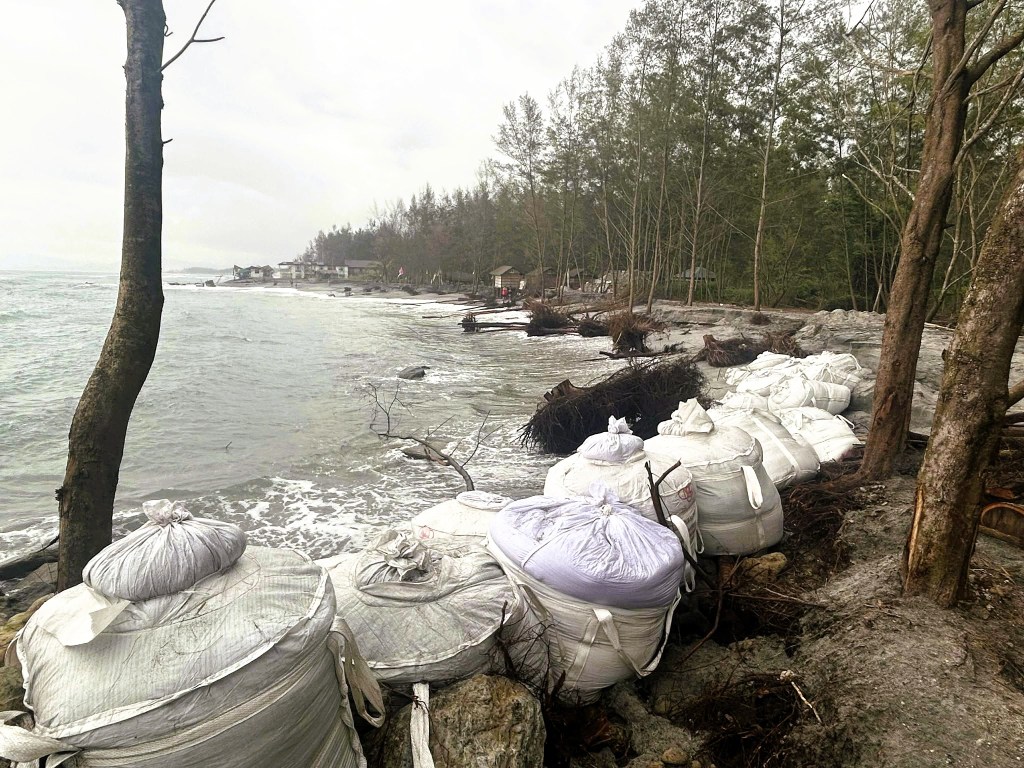
The interviewees said coastal erosion had destroyed cottages and buildings and a coastal road, thus resulting in economic dislocation among resort owners, local workers, and fisherfolk.
The complainants further claimed that erosion was caused by dredging operations in their areas—something that didn’t happen years before dredging started, they said.
Resort owners reiterated these concerns during the Aug. 26 IAC meeting, and asked government officials for measures to solve the problem.
Editha Bugarin of Jhen Beach Resort pointed out that resort owners who invested at Liwliwa helped shore up the local economy by promoting tourism.
“Old Liwa po kami. Kami po ang nagpasikat ng Liwa. Nakinabang naman po lahat e. Mga workers, mga housekeeping. Ang laki po ng kinita ng municipality. The reason: ‘yung investors—ultimo maliit na taong kagaya ko,” Bugarin said.
“Nakakaiyak po eh. Nakakalungkot po talaga. Nag-invest po kami, nag-invest lahat talaga. Wala pong gusto na hindi umasenso po. Para sa lahat po ng Liwa, tulungan na lang po kami,” she added.
It was noted in the meeting that, except for one, the affected resort owners were not residents of Zambales. Some came from Quezon City, Bulacan, Cavite, and as far as Davao, and just bought rights to the properties they occupied.

A resort worker from Liwliwa told HeadlineZambales in a separate interview that the resort owners had invested in good faith.
“Hindi mo rin sila masisisi, kasi noong nagtayo sila ng resort ay ang laki pa ng buhanginan bago ang dagat—halos 400 meters ang layo. Iisipin ba nila na magkakaroon ng ganitong erosion?” he said.
A resort owner from Quezon City, however, said they were not tempted to extend their property into the accretion area because they knew that the sandy expanse was not stable.
“Maraming nagtayo dito noon panahon ng pandemic,” the resort owner added. Their place, which used to be bounded by the seashore, now stands a good hundred meters from the sea, with several new other resorts erected in front in the accreted area.
PROHIBITIONS
It was reiterated in the IAC forum, however, that the accretion areas, where deposits of sand and other debris washed down from the slopes of Mt. Pinatubo accumulated over the years, are still unclassified public lands, and thus cannot be titled, built up with structures, or turned into residential areas.
“I was the CENRO there from 2011 until 2020, and we forbade structures there, except for ‘pala-pala’ or makeshift huts for the use of fishermen and the public when they wished to enjoy the beach,” recalled Zambales Provincial Environment and Natural Resources Officer (PENRO) Marife L. Castillo.
She said that in 2011, they planted 20 hectares of the accretion area in Barangay Sto. Niño with agoho trees to make it somewhat stable, and even put up a fish landing there.
In 2012, she added, the DENR put up a sign in the area to notify the public that the government owned all accreted lands facing the West Philippine Sea, and expressly prohibited building any structure on them.
“The sign is still there up to this day,” Castillo pointed out.
NEED FOR DREDGING
Mines and Geosciences Bureau (MGB) regional director Noel Lacadin, meanwhile, said in the forum that the accreted areas are not yet stable, as they would continue to experience periods of sand build-up due to the continuing flow of lahar downriver during the rainy season. But there will always be time when the sea would wash out the accreted areas, he warned.
He explained that there are at least seven billion cubic meters of lahar deposits along the Maculcol River in San Felipe, but only 50 million cubic meters so far have been taken out through dredging.
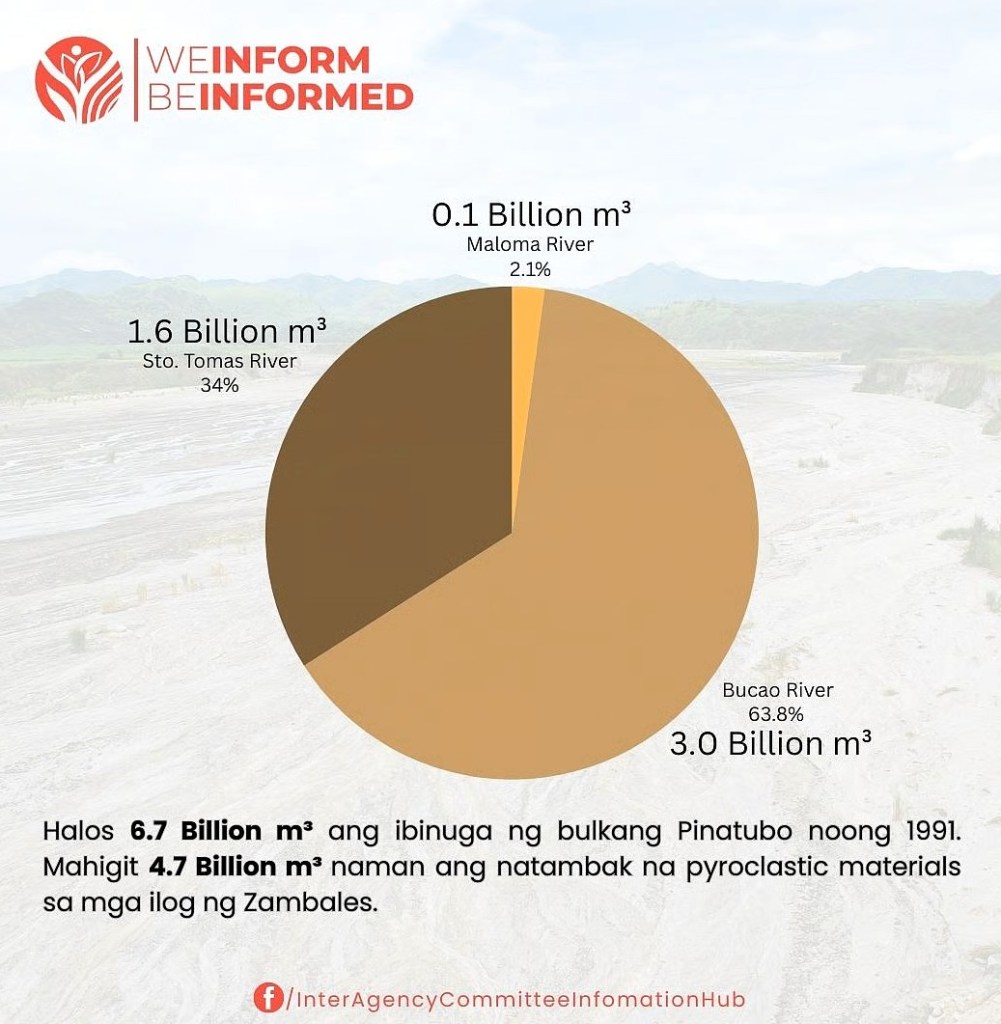
“That is why the river restoration (project) is necessary to prevent the possible spillover of lahar into communities and endangering the greater number of lives and properties along its way,” Lacadin said.
He also reiterated that dredging operations did not cause erosion along the accreted areas. “Strong waves, especially during typhoons and the effects of ‘habagat’ (southwest monsoon) did it,” Lacadin said.
Lacadin had earlier pointed out that accretion had caused the shoreline in San Felipe to extend about one kilometer into the sea, compared to the shoreline mark in 1977.
“There has been coastal erosion before dredging, so therefore, by situational analysis, dredging is not the problem,” the MGB official also said earlier.
IMMEDIATE MEASURES
Engr. Domingo Mariano, head of the IAC technical working group, assured the resort owners that the provincial government is concerned about erosion, which is why resort owners were asked to join the dialogue.
He said the Japan International Cooperation Agency (JICA) has been invited to study waves and scouring patterns in the area to determine possible solutions to erosion. JICA, which implements Japan’s official development assistance programs, provides technical expertise to local partners and conducts master plans for projects.
“We are looking at what measure we can implement, and what policy we can establish regarding this problem,” Mariano added.
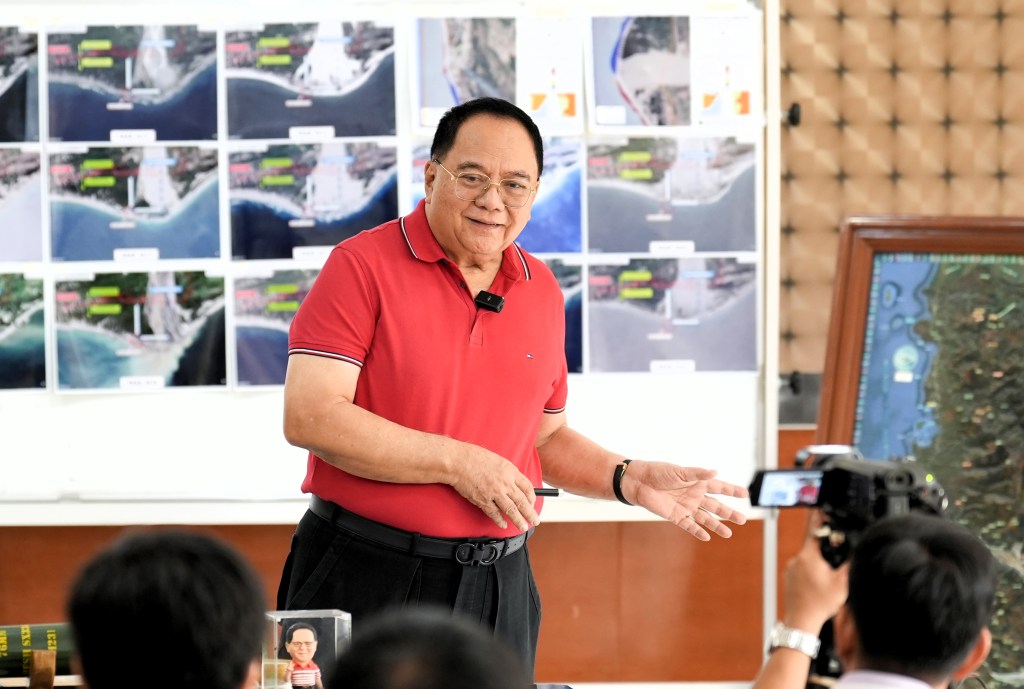
In an episode of the Governor’s Hour broadcast live on social media on Aug. 14, Gov. Ebdane presented Google Earth photos of the Liwliwa area and the nearby mouth of the Sto. Tomas River that drains into the sea between San Felipe and San Narciso towns.
The series of photos from 2010 to 2024 showed how accretion built up a sizeable land mass beyond the protective dike at the river mouth alongside Sitio Liwliwa in Barangay Sto. Niño.
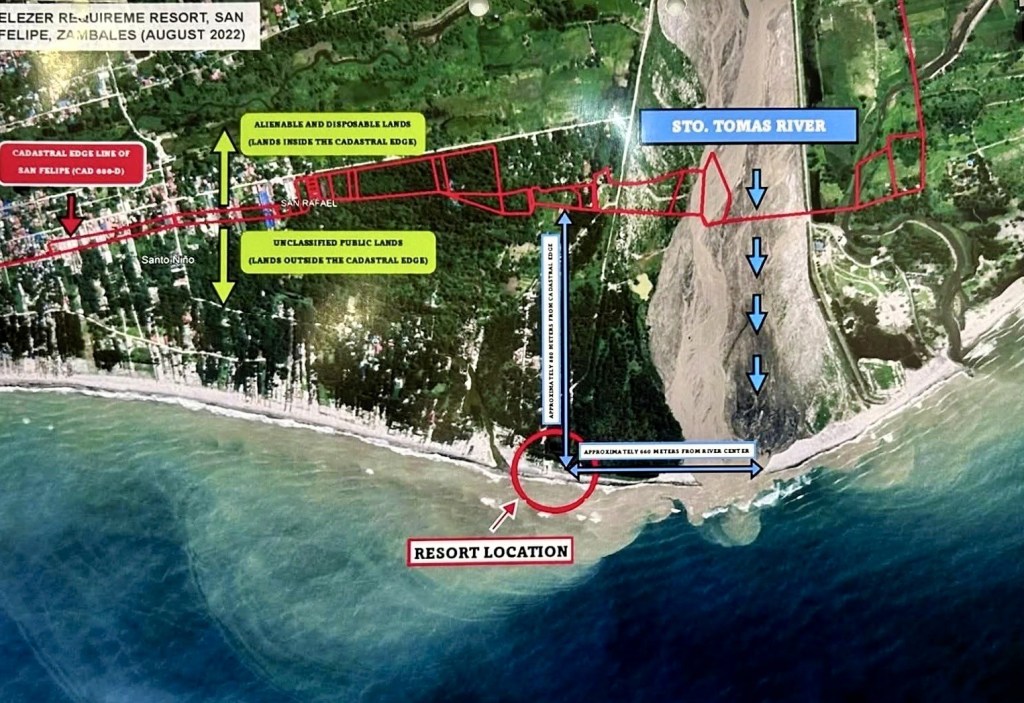
The photos also indicated how an area 660 meters from the center of the Sto. Tomas River and 880 meters from the cadastral edge—the boundary lines of land parcels on record as individual properties—has developed, later becoming a site for resort facilities that were eventually eroded.
Said area, which is well beyond the protective dike, was still under water from 2010 up to 2014, until lahar sand accumulated on it from 2015 until 2020.
Gov. Ebdane, meanwhile said he has issued a memorandum to the effect that illegally-possessed lots will not be issued building permits nor business permits to prevent the recurrence of damage to properties and unsafe habitation. He said the DENR has scheduled technical inspections to establish the delineation of classified lands.
“We need to push for a more structured development of the area and the well-being of the community and the town of San Felipe,” the governor added.
“In the meantime, they (affected resort owners) will be temporarily allowed to occupy the lots they illegally occupied until further notice,” Ebdane said, clarifying further that they would have to present documents like deeds of sale to prove their claims.
COVER PHOTO: The beach resort area at Sitio Liwliwa in San Felipe, Zambales, built mostly on accreted land, suffers from coastal erosion (Photo: Liwa-Liw Beach Villas via Zambales Tourism)





Leave a comment