
By Jose Cielito Reganit | November 16, 2026
MANILA – The Philippines has brought the long-running negotiations for a South China Sea Code of Conduct closer to a historic agreement, securing provisional consensus on nearly 80 percent of the draft’s paragraphs under President Ferdinand R. Marcos Jr.’s leadership as ASEAN chair, House leaders said Monday.
In a statement, Deputy Speaker Paolo Ortega V of La Union credited the Marcos administration’s sustained diplomatic engagement for accelerating negotiations that have stretched over two decades, with the progress achieved under the Philippine chairmanship providing Singapore and other ASEAN partners a stronger foundation for the next phase of discussions.
“From roughly 50 percent to nearly 80 percent provisional agreement in a single year. That is the kind of progress that speaks for itself. Under President Marcos, the Philippines has shown that determined diplomacy, backed by a clear sense of national interest, can move even the most complicated negotiations forward,” said Ortega, whose district faces the West Philippine Sea.
“Look at where we started and where we are today. After more than two decades of discussions, we are now approaching the final stretch of an agreement that could shape peace and stability in the South China Sea for generations. The Philippines helped bring us to this point, and that is something every Filipino can take pride in,” the House leader added.
Ortega made the remarks following Foreign Affairs Secretary Ma. Theresa Lazaro’s announcement that ASEAN and China had reached provisional agreement on about 80 percent of the paragraphs of the proposed Code of Conduct, with negotiations entering their final phase as Singapore prepares to assume the ASEAN chairship in 2027.
Lazaro disclosed that the negotiations had also produced agreement on the relationship between the proposed Code of Conduct and the 2002 Declaration on the Conduct of Parties in the South China Sea, establishing that the new code would build upon the principles of the earlier declaration.
Ortega described the development as an important diplomatic achievement, particularly because the negotiations involve 10 ASEAN member states and China, each with its own interests, priorities and positions on maritime issues.
“Getting 11 countries to agree on the rules that will govern one of the world’s most strategically important waterways takes patience, persistence and considerable diplomatic skill. President Marcos and our negotiating team have demonstrated all three,” the lawmaker emphasized.
“President Marcos has helped move ASEAN and China significantly closer to an agreement. We now have a stronger negotiating text, greater common ground and a clear direction for the work ahead. That is a meaningful achievement for Philippine diplomacy,” he said.
The legislator also welcomed the continuation of discussions under Singapore’s ASEAN chairmanship, describing it as an opportunity to build on the substantial work accomplished under Philippine leadership.
“Singapore will be working with a draft that is substantially more advanced because of the Philippines’ efforts. That is how ASEAN cooperation should work. Each chairmanship builds on the achievements of the previous one, and together we move closer to a common objective,” he said.
He emphasized that the country’s leadership in the negotiations also reflects the broader foreign policy direction of the Marcos administration, which has consistently emphasized diplomacy, international law and cooperation with regional partners in addressing maritime disputes.
“Under President Marcos, we have made significant progress toward a Code of Conduct that can help secure peace, protect our national interests and strengthen stability in our region. That is the kind of leadership the Philippines can be proud of,” Ortega said.
In a separate statement, Deputy Speaker Jay Khonghun of Zambales said the Philippines has laid strong groundwork for completing the South China Sea Code of Conduct, bringing years of negotiations closer to an agreement that could help protect Filipino fishermen and the country’s maritime rights.
As a House leader from Zambales, a province facing the West Philippine Sea, Khonghun said the negotiations were particularly important to coastal communities whose livelihoods depend on safe access to fishing grounds.
“For us in Zambales, the West Philippine Sea is not just about territory. It is about the livelihood and safety of our fishermen and the future of our coastal communities,” he said.
“That is why we support our government’s efforts to reach an agreement that protects our rights and promotes peace and stability in the region,” he added.
Khonghun welcomed the transition as part of ASEAN’s continuing efforts to reach an agreement with China.
“The Philippines has laid the groundwork. Singapore can now build on what we have achieved. What matters is that the negotiations continue moving forward,” he said.
The House leader also expressed support for the Department of Foreign Affairs in pursuing an agreement consistent with international law, particularly the United Nations Convention on the Law of the Sea.
“Our fishermen deserve to earn a living without fear of harassment or intimidation. We want an agreement that helps ensure their safety while protecting our country’s rights,” Khonghun said.
He expressed hope that the remaining issues would be resolved through continued dialogue and cooperation. (PNA)
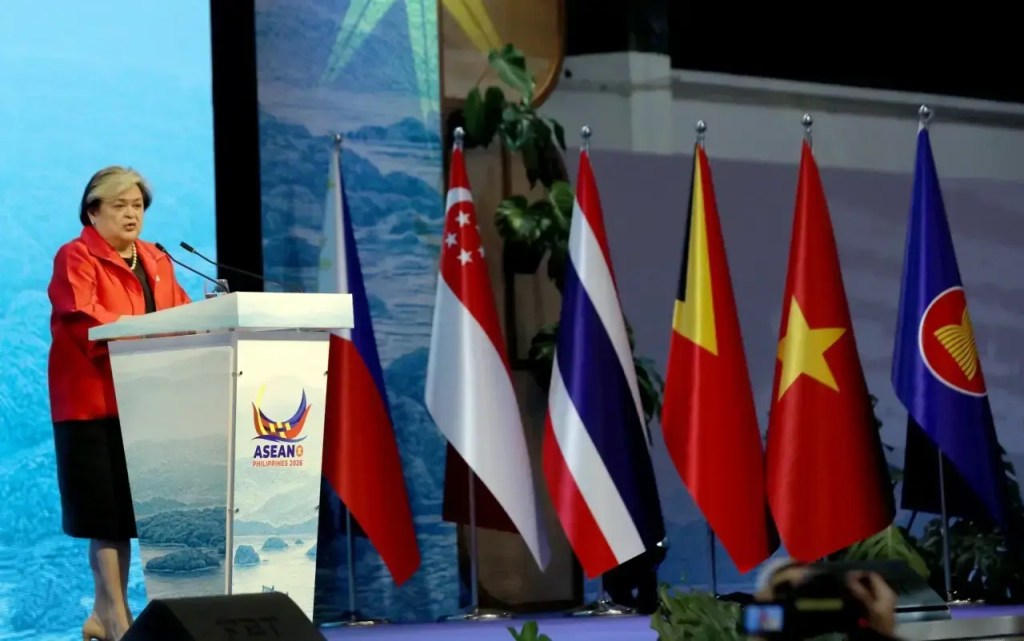
COVER PHOTO: Foreign Affairs Secretary Ma. Theresa Lazaro says 80 percent of the draft Code of Conduct (COC) in the South China Sea has reached “provisional agreement” during a press conference after the 49th Association of Southeast Asian Nations (ASEAN) Summit and Related Summits on Sunday, November 15. (PNA photo by Yancy Lim)



Leave a Reply