
By JOANN AGLIBOT | August 8, 2026
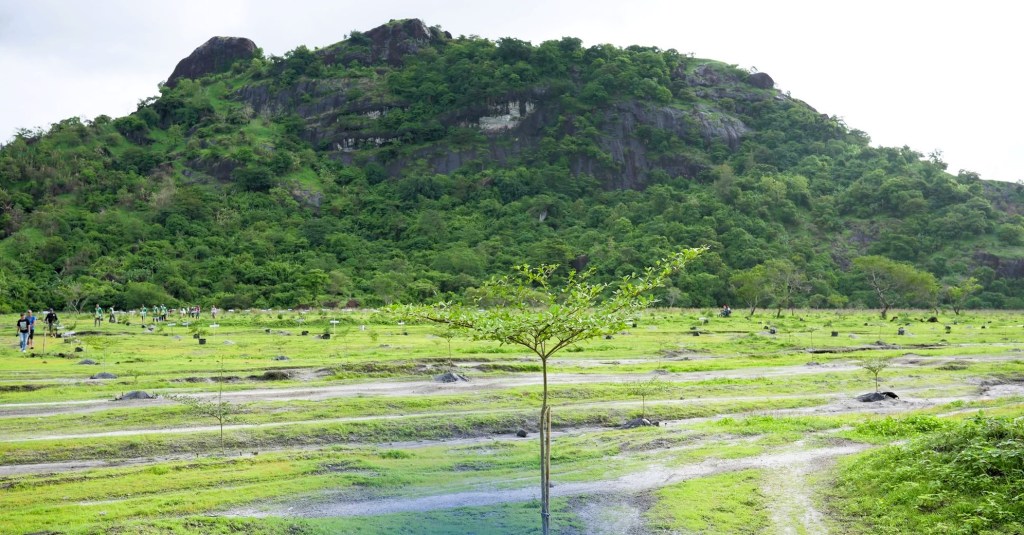
SAN MARCELINO, Zambales — Almost 1,000 African talisay seedlings now stand on Mt. Bagang in Barangay Sta. Fe here, planted through two tree-growing activities aimed at restoring forest cover and strengthening the community’s resilience to disasters.
For Aeta leaders, however, these also highlight the need for environmental efforts to go hand in hand with respecting the voices of indigenous communities who have long considered the area part of their ancestral domain.
The latest activity held on July 31 by the San Marcelino local government, along with volunteer groups, planted 641 African talisay seedlings in observance of the National Disaster Resilience Month.
That activity followed a tree-growing event on June 26, when the municipal government planted around 350 African talisay seedlings in observance of Arbor Day and Philippine Environment Month.
Led by Mayor Elvis Soria and organized by the Municipal Disaster Risk Reduction and Management Office (MDRRMO), the tree-planting activities were held under a public-private partnership with the Philippine Ocean Business Corp. (POBC), a private firm that applied for a Socialized Industrial Forest Management Agreement (SIFMA) to develop a 51.88-hectare tree plantation in Mt. Bagang.
Soria said restoring forest cover helps reduce the risks of flooding and landslides while strengthening the municipality’s climate resilience.
But under DENR rules, SIFMAs in areas covered by ancestral domain claims are generally subject to the requirements of the Indigenous Peoples’ Rights Act (IPRA), including the Free, Prior and Informed Consent (FPIC) process administered by the National Commission on Indigenous Peoples (NCIP).
The DENR, citing information from the Provincial Environment and Natural Resources Office (PENRO) in Zambales, said that the office had no coordination on the tree-growing activities.
NO CONSULTATION
While welcoming the reforestation efforts, Aeta leaders like Trollie Romualdo said they wished they had been consulted before the activities were conducted.
“Why was it done that way? They had already started planting there without first informing us, the Indigenous Peoples,” said Romualdo.
He said the Aeta community is not opposed to the reforestation project but believes activities within their claimed ancestral domain should first be discussed with indigenous communities.
Robert Dela Cruz, the Indigenous Peoples Mandatory Representative (IPMR) in San Marcelino, said the planting site is within the area covered by the Aeta community’s Certificate of Ancestral Domain Title (CADT).
The ancestral domain claim covers around 33,608 hectares across the barangays of Aglao, Buhawen, San Rafael and Sta. Fe here, which is home to the Ayta Ambala, Ayta Mag-Indi and Ayta Zambal groups.
“We are not opposing the project. We only wish the Indigenous Peoples had been informed first,” Dela Cruz said.
INCOMPLETE FPIC PROCESS
According to Dela Cruz, POBC has met several times with community chieftains, elders, Indigenous leaders, the NCIP in San Marcelino and the IPMR under the FPIC process.
But the FPIC process has not yet been approved, Dela Cruz pointed out. “They should not have proceeded while the (FPIC) process has not yet been completed,” he said.
Dela Cruz also said the consultations have resulted in differing views among affected communities, prompting the Sangguniang Katutubong Aeta ng San Marcelino to resolve that only the indigenous communities directly affected by the proposed project should decide whether to give their consent or not, with neighboring communities supporting whatever decision they reach.
MDRRMO head Arsenio Edar Mauricio III, meanwhile, said the local government had no intention of disregarding the concerns of the Indigenous community.
“The area where we planted is within a fenced property because our coordination was with POBC, which is a private corporation, and the activity was conducted within its perimeter fence,” he said.
Mauricio said he could not confirm whether the site forms part of the Aeta ancestral domain, but added that the local government is willing to sit down with the Indigenous community to discuss their concerns.
“If they have those sentiments, they may bring them to the mayor or to our office so we can sit down and discuss them,” Mauricio said. ▲
COVER PHOTO: Volunteers plant African Talisay seedlings on June 26 at the foot of Mt. Bagang, an area that indigenous Aeta groups claim to be part of their ancestral domain (San Marcelino LGU)


 Headline Zambales
Leave a comment