
By Marifel Faith S. Hammond | April 28, 2026
CEBU CITY, Cebu (PIA) — For 18-year-old Grandis B. Frias, science is not about theories. It is about solving real problems using throw-away materials.
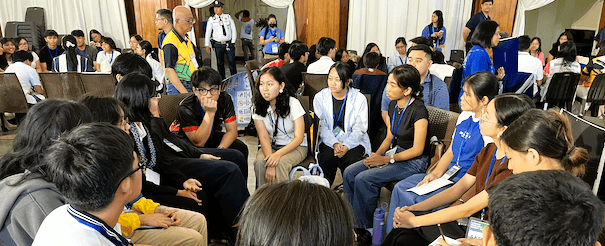
A Grade 12 DOST scholar from the Philippine Science High School (commonly Pisay) Main Campus in Quezon City, Frias was among 201 scholars from 16 campuses nationwide who gathered in Cebu City for the PSHS System Science Research Summit 2026, hosted by the Central Visayas Campus.
Themed “Resilience Amidst Disaster,” the summit brought young researchers into dialogue with experts from the National Research Council of the Philippines (NRCP). PSHS System Executive Director Ronnalee N. Orteza framed the event’s purpose plainly in her research address.
“It is an avenue to showcase solutions relevant to sustainability, where young minds, such as you, begin to see themselves as creators, not just learners,” she said.
For Frias and her research group, that meant tackling a persistent problem in the pharmaceutical industry — the instability of gelatin-based soft capsule film sheets in hot climates.
In a country like the Philippines, where temperatures are consistently high, gelatin film sheets used in soft capsules can soften or melt during transport and storage, causing significant product losses.
“Ang problema po kasi sa film sheets ngayon ay gawa po sila sa gelatin. So, madali po sila matunaw. Problema po yun dito sa Pilipinas kasi, yun nga, mainit,” Frias said.
(The problem with film sheets today is that they are made of gelatin. They melt easily. This is a problem here in the Philippines because it is hot.)
Their solution came from an unlikely source: discarded mango seeds collected from local vendors. From these, the group developed a starch-based film alternative with a melting point of around 200 degrees Celsius — far more stable than gelatin and better suited to tropical conditions.
Heat resistance, however, was only part of the challenge. Starch-based materials tend to be brittle. Over two years, Frias and her team ran extensive experiments, adjusting ingredient ratios to improve both strength and flexibility.
“Ang focus po namin ay kung paano siya palalakasin. Nakahanap naman po kami ng optimized ratio na comparable sa commercially available soft capsules,” Frias said.
(Our focus was on how to strengthen it. We found an optimized ratio comparable to commercially available soft capsules.)
The research stands out for two reasons beyond its technical results. First, the raw material — mango seed starch — is agricultural waste that would otherwise be discarded. Second, the plant-based alternative addresses an ethical concern: conventional gelatin is derived from animal byproducts.
“Tinatapon na lang po siya, usually. Pero pwede pa pala siyang magamit into something valuable” (Usually, these are just thrown away, but they can actually be used to make something valuable), Frias said.
Frias and her group are now pursuing intellectual property protection for their work, with plans to publish their findings and explore potential industry applications.
The summit itself played a role in shaping that path. Students engaged directly with NRCP experts, receiving feedback, mentorship, and access to professional networks — an experience Frias said she felt was genuine.
“Sobrang thankful po kami dun sa panelists, sa resource speakers po na kinukuha nila kasi naramdaman po talaga namin na nandito sila para tulungan kami,” she said.
(We are really thankful to the panelists and resource speakers they brought in. We truly felt they were there to help us.)
After the dialogue, the summit held a Community Fair where scholars presented their research through simplified posters designed for younger audiences, including grade school students in Cebu — an effort to make science more accessible beyond the academic setting.
For Frias, the journey carries a personal dimension. Coming from a family that could only afford public education, the PSHS scholarship opened a door she might not otherwise have reached.
“Libre po lahat — tuition, allowance. Malaking tulong po talaga (Everything is free — tuition, allowance. It is a really big help),” she said.
At the Science Research Summit 2026, students like Frias make the case that innovation can start with something as simple as a discarded seed — and the determination to see what it could become. (MSH/PIA-7 Cebu)




Leave a comment