
By Alex Lumaque | October 31, 2025
DUMALAG, Capiz (PIA) — In today’s age of visually driven media, even places of silence and remembrance have become spectacles that captivate the eye and stir curiosity.
Take, for instance, the circular cemetery of Dumalag, Capiz—a hidden heritage site that has only recently stepped into the light.
Once an untold story, it was rediscovered during the initial phase of the town’s Cultural Mapping and Profiling Project about a decade ago.
Locals fondly call it “Campo Santo,” a name that evokes both reverence and familiarity. Like the nearby 19th-century Catholic church, the cemetery was built under the guidance of Fr. Ángel de Abasolo, an Augustinian priest who served the people of Dumalag from 1864 to 1879.
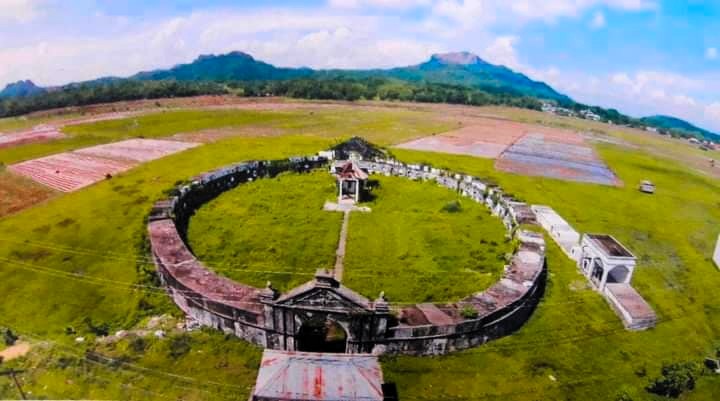
What makes this burial ground remarkable is its unique circular design—a rare feature among Spanish-era cemeteries in the Philippines.
Historical accounts note its resemblance to the iconic cemeteries of Paco, Manila, and Nagcarlan, Laguna, both celebrated for their distinct architectural layouts and enduring charm.
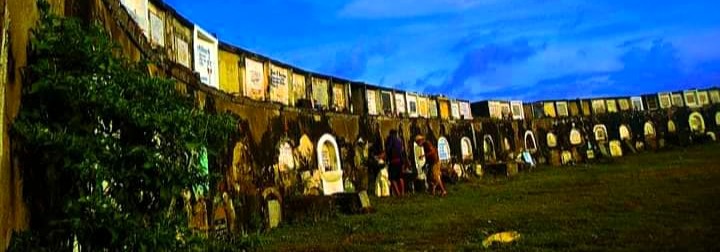
Considered the oldest cemetery in the province, the Campo Santo is encircled by limestone rock walls—the same materials used to construct the town’s Catholic church. Within its confines, burial niches are built into the circular walls, while a modern chapel now stands at the center.
Its façade is simple, topped with a triangular pediment.
Behind the central chapel, directly opposite the main gate, lie the ruins of the original Spanish-era chapel, a quiet testament to Dumalag’s colonial past.
Local researcher and author Christian George Acevedo describes the cemetery as an architectural rarity. He admits that no existing documentation explains the reason behind its circular design.
But in Christianity, such a layout often symbolizes resurrection and eternal life.
Acevedo, who also serves as the information officer of Capiz State University, has written extensively about other heritage burial grounds, including the Masonic Cemetery of Capiz, the Catholic Cemetery of Banica in Roxas City, and the Panay Catholic Cemetery in Panay town.
In one of his articles, he reminds readers that “neglected cemeteries are heritage sites too.”
Today, the Campo Santo of Dumalag stands as more than just a resting place—it is a silent witness to the town’s rich past, a space where history, faith, and architecture converge.
Even in death, it reminds us that beauty and heritage endure, captivating the modern gaze with their quiet grace. (AGP/AAL/PIA Capiz/Photos from Amazing Dumalag FB/Capisnon.com)





Leave a comment