
By HENRY EMPEÑO
MASINLOC, Zambales — The Zambales Provincial Disaster Risk Reduction and Management Office (PDRRMO) has asked local government units (LGUs) to identify possible evacuation areas across the province following a series of earthquakes that jolted various places in the country, including Zambales.
PDRRMO head Rolex Estella said this is part of the instruction by Governor Hermogenes Ebdane Jr. for LGUs to review disaster contingency plans and formulate courses of action to mitigate the effects of disasters.
“We’re looking for open spaces in all municipalities that could be used as tent cities should a strong earthquake happen,” Estella said, just hours before two tremors hit Zambales in the early morning of October 16.
Estella explained that earthquake scenarios presume that existing evacuation centers, which usually are public schools and barangay facilities, won’t be viable during severe tremors, as they may be prone to collapse.
Moreover, as earthquake location is unpredictable, “evacuation plans really become a challenge, so there is really a need to pinpoint safe spaces beforehand,” he said.
Zambales was rocked by two earthquakes that occurred within five minutes of each other on October 16. A magnitude 3.2 earthquake was recorded at 2:04 a.m. four kilometers west of Masinloc, followed by a magnitude 5.0 at 2:09 a.m. 8 kilometers west of the same town. Both occurred at a depth of 24 kilometers.
On October 11, another magnitude 5.0 earthquake also shook Zambales. So far, no damages nor casualties have been reported after the earthquakes.
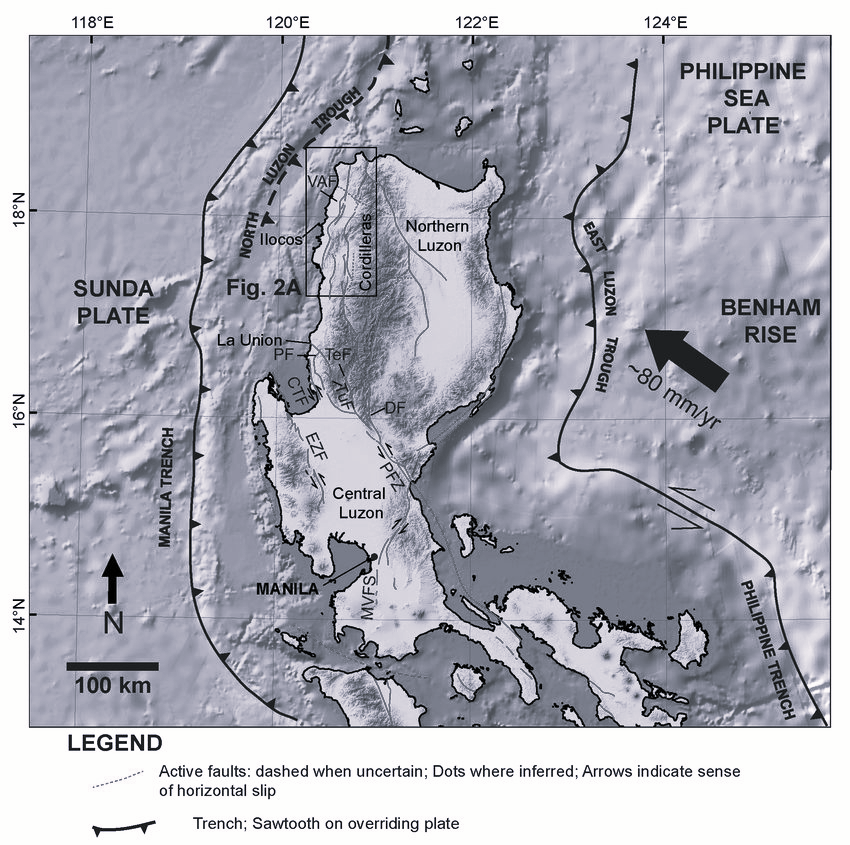
Studies show that at least two active fault lines run across parts of the province: the East Zambales Fault, which extends offshore in the Lingayen Gulf in Pangasinan north of the province, and the Iba Fault, which is located inland in central part of Zambales. Both are said to be part of a larger system of tectonic structures in the region, including the Bataan Volcanic Arc Complex (BVAC).
The Manila Trench, which is located west of Zambales, is also associated with frequent earthquakes and is said to have shown some activity with magnitude 5.0 and above tremors in 2024 and 2025.
Estella said Gov. Ebdane has encouraged LGUs to adopt a three-tiered approach to prepare for a possible “Big One,” a projected magnitude 7.2 earthquake that could affect Metro Manila and nearby provinces due possible fractures along the West Valley Fault that extends from Bulacan to Laguna.
This involves identifying risks and developing plans of action, executing response and mitigating measures during disaster, and assessing the plan’s overall effectiveness afterwards.
The LGUs are expected to update their contingency plans and submit the same to the Provincial Disaster Risk Reduction and Management Council, which Ebdane chairs, Estella added.





Leave a comment