
By Henry Empeño | September 11, 2024
SUBIC BAY FREEPORT — The Subic Bay Metropolitan Authority (SBMA) declared on Wednesday its commitment to bring to zero balance all the carbon footprint of industries, business establishments, offices and households in the Subic Special Economic and Freeport Zone within 16 years.
SBMA Ecology Center manager Amethya dela Llana, who read the SBMA declaration during the opening of the two-day Central Luzon Sustainable Tourism Summit at the Subic Bay Exhibition and Convention Center here, said the Subic agency will balance out carbon emissions by increasing the capacity of Subic’s natural ecosystem to absorb greenhouse gases.
The bottom line is that carbon-neutrality will become SBMA’s “new way of life,” the declaration stated.
Subic, which became a special economic zone in 1992, now boasts of some 1,800 registered investors employing more than 158,000 workers. It is also home to thousands of residents living in three housing areas.
Dela Llana said SBMA’s pledge for carbon neutrality was made in support of the government’s 2021 commitment to the Paris Agreement on Climate Change for a 75 percent reduction of greenhouse gases under the first nationally-determined contribution.
She added that under this program, the SBMA will seek to make Subic the first carbon-neutral economic zone in the country.
Among the measures defined by the SBMA for its carbon-neutral objective, expanding the green footprint of the local environment is expected to be the key to the success of this program.
Dela Llana said the SBMA will leverage the 10,000-hectare Subic Watershed Forest Reserve, and an estimated 60 hectares of wetlands and mangrove area, as well as seagrass beds in the bay, which are natural carbon sinks.
Subic’s coastal and marine ecosystem, it was explained, could store the so-called “blue carbon”, which are carbon dioxide sequestered in the soil and silt under the seabed.
The SBMA will protect and restore Subic’s natural ecosystem, Dela Llana said, “so it can do what it does best – capturing carbon emissions.”
Aside from these, the SBMA also committed to establish a roadmap for net zero-carbon buildings inside the Subic Bay Freeport Zone; develop a set of supporting incentives and programs that will enable Subic business locators to achieve net-zero targets; and use emerging technologies leveraging renewable energy.
Previously, SBMA Chairman and Administrator identified the “Shore Power Connection for Carbon Neutral Ports” project as an SBMA initiative to reduce emissions in the free port.
Aliño said this will provide shoreside electrical power to a ship at berth while its main and auxiliary engines are shut down, cutting air pollution from ships at berth by 95 percent. The project will be the first of its kind in the country, he added.
Aliño said other projects in the pipeline involve decarbonizing buildings and transportation, adopting low-carbon infrastructure designs, energy efficiency and conservation, leveraging renewable energy sources, as well as solid waste and wastewater management.
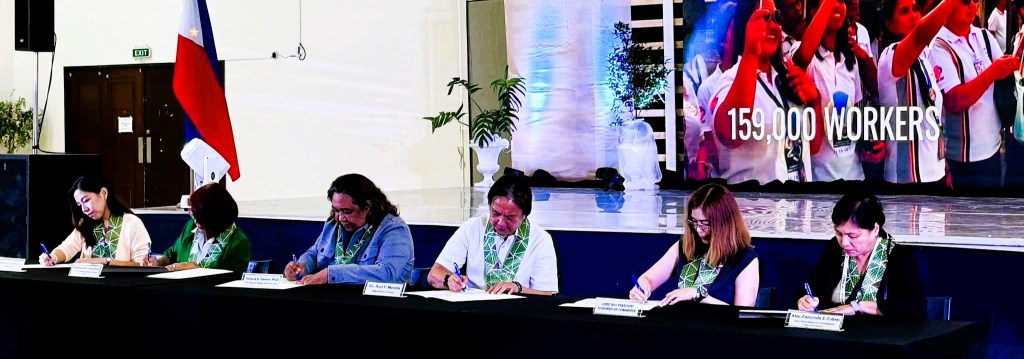
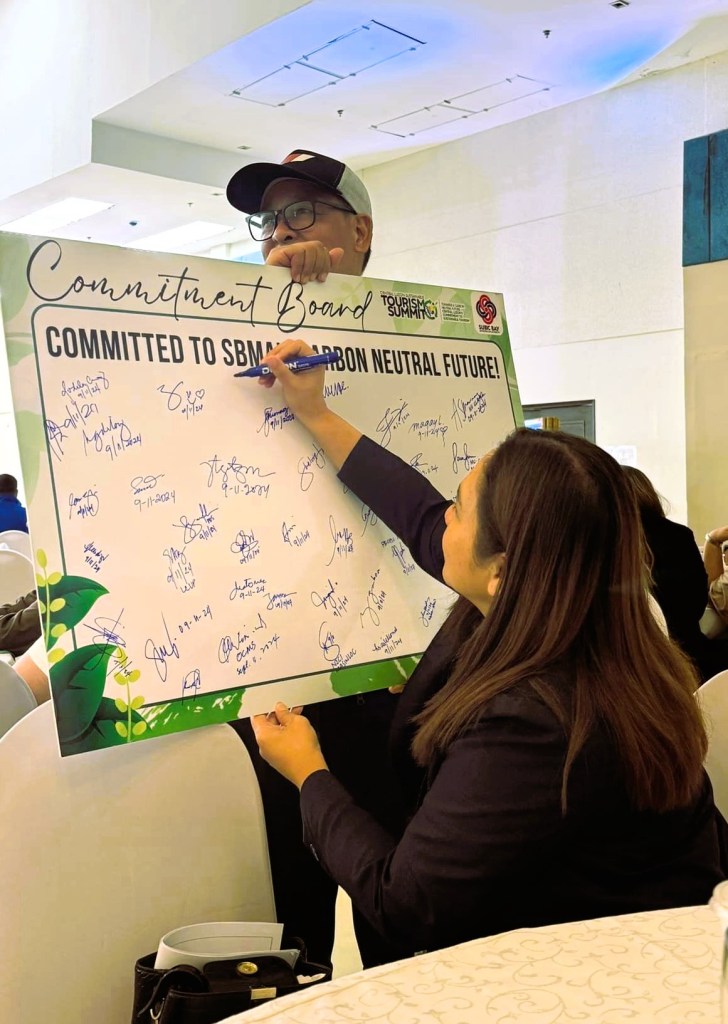
In the launch of the program last Wednesday, delegates to the tourism summit also signed the SBMA Declaration of Carbon Neutrality. These included Tourism Regional Director for Central Luzon Richard Daenos, SBMA Director Raul F. Marcelo, Hospitality Alliance of Subic Bay Freeport Zone representative Pamela S. Konghun, Subic Bay Chamber of Commerce representative Donna May Tamayo, and Atty. Carminda Z. Fabros of the Subic Clark Alliance for Development. (30)
PHOTOS:
Guests and delegates to the 2024 Central Luzon Sustainable Tourism Summit sign the SBMA Declaration of Carbon Neutrality (Photo by SBMA Ecology Center)



Leave a comment