
Zambales and Olongapo try hard measures vs. ‘Public Enemy No. 1’
By HENRY EMPEÑO | September 4, 2021
OLONGAPO CITY — Extraordinary times call for extraordinary measures. And in the fight against a resurgent Covid-19 virus, government officials in Zambales and this city are boosting their arsenal with anything from granular lockdowns and containment zones, entry restrictions and barangay checkpoints, enforced antigen testing at the border, and yes, red flags to mark areas with high incidence of cases.
Zambales Gov. Hermogenes Ebdane Jr. said the confirmation of Covid-19 Delta variant cases in the locality, as well as the rapidly increasing surge of cases in three municipalities, had prompted the provincial inter-agency task force (PIATF) to “escalate the quarantine classification of Zambales” to general community quarantine (GCQ) with heightened restrictions on August 21.
“Our medical team is already overwhelmed with the continuous Covid1-19 infections in the province,” Ebdane said, as he gave the order to enforce harder measures.
“With its constant mutations and its capacity to wreak significant political, economic and social upheaval, Covid-19 could be considered today as Public Enemy Number 1,” Ebdane said.

TOUGH CHOICES
Zambales, which previously enjoyed relatively lax controls under a modified general community quarantine (MGCQ) classification, had reverted back to restrictions that were lifted just a few months ago when infections were tapering down.
Today, curfew hours had been lengthened by three hours—from 10:00 p.m. to 4:00 a.m. previously to 8:00 p.m. to 5:00 a.m. and persons below 15 years and over 65, as well as those with immunodeficiency, comorbidity or health risks, as well as those pregnant, are required to remain in residences at all times, regardless of vaccination status.
Liquor ban is enforced provincewide, religious gatherings are limited to 10% of the venue capacity, al fresco dining to 30%, and only immediate family members can join mass gatherings like wedding, birthdays and funerals.
Meanwhile, hotels are open at 30% capacity, but other services like dining and spa are disallowed, just like those at indoor entertainment venues—bars, cafes, karaoke joints, casinos and cockpits, even amusement centers and sports courts—that continued to be closed to the public.
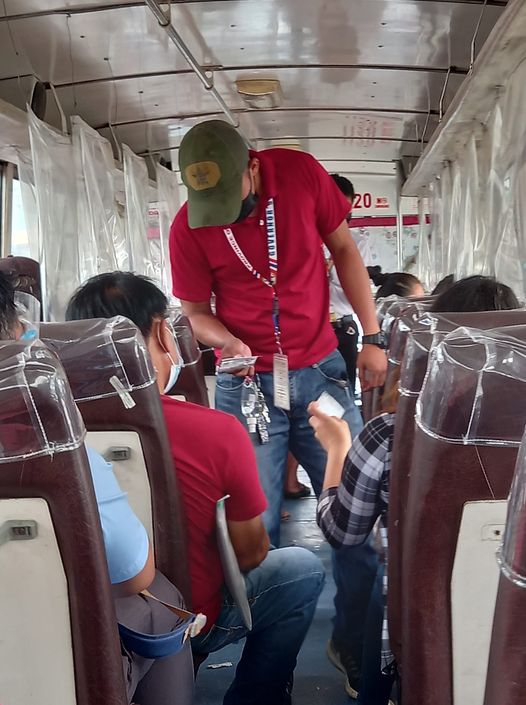
At the border, PIATF personnel who are ordered to make scrupulous inspection of travel passes and Covid-19 test results, enforce a “mandatory test upon entry” rule—a tough measure that initially earned public disapproval but soon gained “normalcy” in these abnormal times.
This border regulation required all workers residing in Zambales but working elsewhere, or those residing elsewhere but working in Zambales and crossing the Subic or Sta. Cruz town border daily, to take a rapid antigen test weekly, either at the border triage or their respective rural health units.
On the other hand, travelers from areas under Enhanced Community Quarantine (ECQ) or modified ECQ who would stay in Zambales for more than 24 hours, are required to submit a negative results of reverse transcription-polymerase chain reaction (RT-PCR) 48 hours prior to entry.
Aside from PIATF checkpoints at the border, barangays are authorized to make similar inspections where necessary, as the fight against Covid-19 shifted back to the local level.
In cases where five or more positive cases are confirmed in an area, granular lockdowns in barangays would be put in effect.
RED MARKERS
In Olongapo City, which maintains a separate count of Covid-19 cases, a similar situation of Covid-19 surges and the emergence of cases of Delta variant prompted the city government to “re-establish stricter quarantine protocols and restrict movement to minimize possible virus transmission.”
In an order signed by Mayor Rolen Paulino Jr. on August 31, the city effectively imposed curfew from 10:00 p.m. to 4:00 a.m., restricted the movement of persons below 15 years and over 65, enforced border control at the two major entry points in the city, and limited persons in public areas to just 30% of venue capacity.
Paulino also ordered granular lockdowns as necessary “to contain localized spikes in Covid-19 cases and prevent further increase and spread of the virus.”

The order for granular lockdown also officially operationalized the red-flagging of areas with high Covid-19 cases, a practice introduced at Barangay New Kalalake last August when officials placed red flags at street corners to warn passers-by of the imminent danger in the area.
The city also prohibited leisure travel, and banned the entry of travelers from ECG, MECQ and GCQ areas except when accessing essential goods and services.
Returning residents from ECQ and MECQ zones are also required to present a letter of acceptance from the barangay of destination, and should quarantine for 14 days upon arrival.
CONDITION CRITICAL
Most residents agree that the tough measures are needed under the circumstances—when Covid-19 numbers are rising and when their own lives and those of their loved ones are at stake.
According to the Department of Health (DOH), there were already 4,785 confirmed Covid-19 cases in Olongapo as of September 1. Of these, 451 are active, 4,192 are recoveries and 143 are deaths.
In Zambales at the same date, records showed a total of 7,206 confirmed cases with 770 of them active, 6,221 recoveries, and 215 deaths.
While these figures were way lower than other areas in Central Luzon in the same period—Bulacan, for example, had 76,387 confirmed cases with 7,233 of them active, while Angeles City had a total of 11,665 with 853 active—the spiraling cases simply cannot be ignored.

Figures from the Zambales Provincial Health Office (PHO) indicated that daily new Covid-19 cases increased from zero last March 1 and single-digit numbers in the first two weeks of said month to record number of cases that brought the provincial hospital to critical admission level in recent months.
Thus, from a total of 175 active cases on March 31, the PHO counted 277 on April 30; 427 on May 31; 614 on June 30; 367 on July 31; and 928 on August 31.
Records also show the growing gap between the number of confirmed cases and those who have recovered: 1,257 confirmed to 1,054 recovered at the end of March; 1,835 confirmed to 1,517 recovered in April; 2,474 confirmed to 1,993 recovered in May; 3,390 confirmed to 2,695 recovered in June; 4,294 confirmed to 3,811 recovered in July; and 6,098 confirmed to 4,983 recovered in August.
Daily news cases outpaced recoveries even more last month when the PHO recorded 22 new cases and 21 recoveries on August 1; 30 new cases to 18 recoveries on August 5; 36 new cases to 25 recoveries on August 10; 109 new cases to 28 recoveries on August 15; 111 new cases to 27 recoveries on August 22; and 108 new cases to 62 recoveries on August 25.
FULL FACILITIES
The growing cases continue to strain the capacity of local hospitals and medical facilities. Two weeks ago, Baypointe Hospital and Medical Center, which is the only hospital in the Subic Freeport Zone that admits Covid cases from Olongapo City, Bataan and Zambales, accepted a medical tent from the Philippine Red Cross to augment its Covid-19 isolation and treatment capacity.
Subic Bay Metropolitan Authority (SBMA) Chairman and Administrator Wilma T. Eisma, who facilitated the Red Cross donation, said the medical tent is invaluable to the Subic Bay Freeport because of the rising number of Covid cases in the locality.
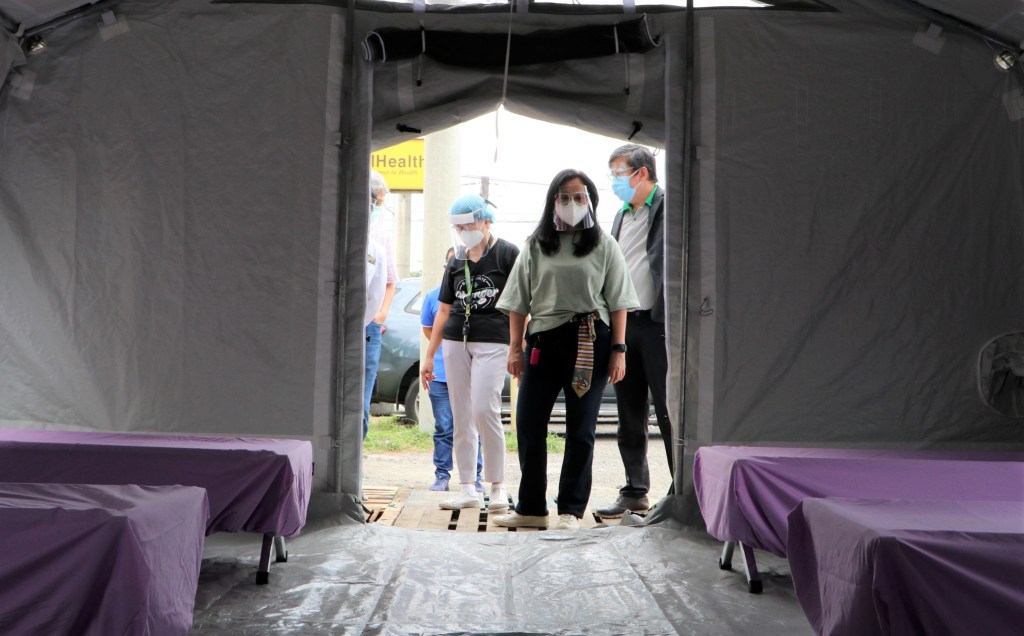
Dr. Erlinda Alconga, Baypointe’s infectious diseases expert, said more patients are seeking admittance at the hospital because they have Covid pneumonia.
“Before, our bed capacity for Covid cases was only 29, but now we attend to about 40 to 50 patients at Baypointe,” Alconga explained. At that time, Alconga said that a total of 68 patients were in the waiting list of those seeking admittance.
Last week, the government-owned James L. Gordon Memorial Hospital (JLGMH) in Olongapo City followed suit and erected its own tent outside, while the Zambales government said it will put up with the Department of Public Works and Highways a modular-structured hospital to increase local capacity.
At the same time, hospital officials announced that they would limit admissions of OB-Gyne and pediatric patients because a lot healthcare workers at JLGMH had tested positive of the virus.
Last week, the SBMA similarly suspended all face-to-face operations at its medical dispensary and satellite emergency unit at the Subic airport due to lack of personnel necessary for normal operations.
SBMA’s Eisma said this was because 13 frontline health workers of the agency had tested positive for Covid-19 and had to be on quarantine for 14 days.
FAILURES AND FOILS
So, where and how did Covid-19, the ultimate Public Enemy Number 1 in Zambales and elsewhere, gain an upper hand? And what could be done locally to win the war?
With local community transmission of the virus and the limited capacity of local medical facilities, experts say the battle has shifted back to local frontlines, particularly among individuals.
In a recent public appeal, the Olongapo City Medical Society (OCMS) implored residents to help fight Covid as a community, noting that city hospitals “are in full capacity and with long queues of patients still awaiting beds.”
“Please do your part to help stop the spread of this highly infectious SARS-NCOV-2 virus that is currently causing a surge of cases,” the OCMS said. “It has already infected a lot, and will continue to infect more if we don’t act now and act fast.”
The medical group then urged the public to observe basic health protocols like wearing masks and face shields; washing hands and disinfecting surfaces; observing social distancing; and most of all, staying home and leaving only for essential travel.

Aside from urging residents to observe basic health protocols, local officials call on them to get vaccinated. In Zambales, the PHO has reported a total of 49,553 individuals having had their first dose and 57,027 having completed their second dose. In Olongapo, meanwhile, around 32,000 individuals, or 10% of the population, have been fully vaccinated said Olongapo vice Mayor Jong Cortez.
“Vaccination is the key,” noted Cortez in a reply to inquiry by BusinessMirror. “The more the national government supplies vaccines to every LGUs and we could administer it to our people, the sooner we can protect ourselves and restart the economy.”
“But we must exercise caution regarding the revised target and program of so-called population protection by the national IATF of vaccinating 50% of the population instead of the original goal of 70% to achieve herd immunity,” he added, pointing out that the latter goal is “the tried and tested benchmark in over 40 years of controlling pandemics.”
Cortez said people are no longer reluctant to get vaccinated, but are now eager to get inoculated since the emergence of the more transmissible Delta at Lambda variants. “Still, some people tend to be choosy when it comes to vaccine brands,” he observed.
Cortez also said that public attitude on the pandemic is also important. “In the absence of vaccines, our safety and health is entirely dependent on the cooperation and discipline of everybody by following IATF health protocols and taking a positive mindset—that I am positive, you are positive, and everybody is positive,” he said. ~




Leave a comment