
By CARRIE T. ASPA |
SUBIC BAY FREEPORT (March 24) — Doctors and other health workers in Subic Bay Freeport area on Tuesday learned how to take swabs of specimen from patients, as well as how to properly put on and take off masks, gloves and goggles after testing for the new coronavirus (Covid-19).
They also discussed the algorithm prepared by the Department of Health (DOH) for detecting and diagnosing Covid-19 patients and watched a demonstration on the sanitary disposal of said personal protection equipment following testing.
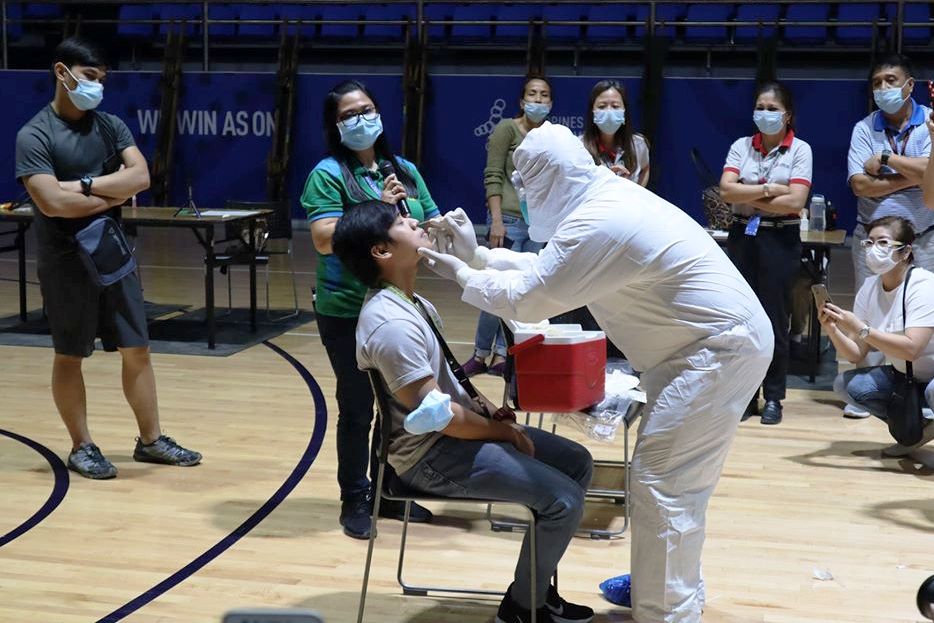
These are the focus of a training conducted by the Department of Health’s Regional Epidemiology and Surveillance Unit (DOH-RESU) to acquaint local health workers with proper medical protocols in responding to potential Covid-19 patients.
But SBMA Chairman and Administrator Wilma T. Eisma said that aside from boosting the competence of local health practitioners, the training served as a capacity-building exercise that also sought to establish cooperation procedures among local hospitals during the Covid-19 emergency.
“This is what we need to have here—an integrated community response to the Covid-19 threat because our areas are interconnected,” Eisma said.
“Between the hospitals at the Subic Bay Freeport and Olongapo City, we have only around 20 isolation rooms. We really have to wisely allocate local resources,” Eisma added.

The training held at the Subic Freeport gymnasium involved personnel from the Subic Bay Metropolitan Authority’s Public Health and Safety Department (SBMA-PHSD), Baypointe Hospital and Medical Center in the Subic Freeport, and James L. Gordon Memorial Hospital and ZMMG Coop Hospital in Olongapo City.
“This is very important because the medical personnel need to have the knowledge and skills on how to properly respond to Covid-related incidents and emergencies,” said Dr. Solomon R. Jacalne, head of the SBM- PHSD and commander of the SBMA’s Incident Management Team (IMT).
“The training we have attended is part of our preparations for the mobilization of our IMT,” he said.
Jacalne assured the public, however, that the Subic Bay Freeport Zone remains a zero-Covid-19 area at the moment. He, however, urged the public to cooperate with authorities to keep the virus at bay.
“The main challenge we are now facing here is keeping the people inside their homes. Some, we observe, are not yet taking this (Covid-19 threat) seriously. That is why we don’t stop with our information campaign,” Jacalne said.
He said the strict implementation of home quarantine is vital, as well as the regulated entry and exit and curfew hours imposed by the SBMA. “These should be obeyed for the safety of us all,” he added.
Meanwhile, SBMA Deputy Administrator for Public health and Safety Ronnie Yambao pointed out that the DOH training on Covid testing had integrated both public and private hospitals in a unified approach to equip and prepare health workers and the local community for any Covid-19 case.
“We are preparing our medical workers as part of the strategic program of the SBMA because only DOH Covid Test Centers have the capability to generate and validate results like the Research Institute for Tropical Medicine (RITM) and San Lazaro Hospital,” he added.


Leave a comment