
By HENRY EMPEÑO |
SUBIC BAY FREEPORT — Korean shipbuilder Hanjin Heavy Industries & Construction Philippines (HHIC-Phil) went to court on Tuesday to initiate voluntary rehabilitation under Republic Act 10142, otherwise known as “An Act Providing for the Rehabilitation or Liquidation of Financially Distressed Enterprises and Individuals”.
According to Hanjin Heavy Industries & Construction Co., the mother firm in South Korea, its Subic affiliate filed for an insolvency scheme following “a drop in new orders amid the protracted slump in the global shipbuilding sector.”
Hanjin’s petition to seek relief from creditors sent a shockwave of surprise in the business community here, which has seen the meteoric rise of the South Korean firm since it started operation here in 2006.
“It’s really sad that Hanjin would be in dire financial straits after successfully building some of the world’s biggest ships here and putting the Philippines in the map as the world’s fifth largest shipbuilder,” said Subic Bay Metropolitan Authority (SBMA) Chairman Wilma T. Eisma, who met with a high-ranking Hanjin official last Saturday to discuss the rehabilitation scheme.
As of late November last year, Hanjin still sounded optimistic as it announced the delivery of two units of 114,000-deadweight crude oil tankers to its Singapore-based client Eastern Pacific Shipping (EPS).
Hanjin reported on its website then that EPS was also expecting two more tankers of the same kind for delivery in the first quarter of 2019. “And with the positive business momentum of HHIC Phil and Eastern Pacific shipping, the latter have ordered two more tanker vessels that (are) set to start construction in the 2nd quarter of 2019,” the Hanjin report added.

Too Big to Fail
Such optimism was characteristic of a company which has delivered 123 vessels since July 2008 when it rolled out “Argolikos,” the first container ship to be built in the Philippines. That record meant that the company was churning out production at the rate of more than 12 vessels a year.
The Subic shipbuilder is a subsidiary of Hanjin Heavy Industries and Construction Co., Ltd. (HHIC), the South Korea-based multinational that provides shipbuilding, construction, and plant services worldwide, and is thus backed by one of the biggest chaebols, which are conglomerates with affiliated companies.
Hanjin initially pumped $1.7 billion to complete its 300-hectare shipyard at the Redondo Peninsula in Subic, Zambales in record time, and in 2016 the company’s foreign direct investment stood at US$2.3 billion, the biggest in Subic since the free port was established in 1992.
By August 2015, Hanjin was already the single biggest employer in the Subic Bay Freeport, with workers at its Redondo shipbuilding facility making up 36% of the total Subic workforce. That year, the SBMA said it expected Hanjin workers to breach the 30,000 mark, as the company was signing more shipbuilding contracts.
In the same year, the SBMA credited Hanjin as among the major growth contributors in the Subic Freeport as the firm set out to complete at least 17 ships worth over US$1.6 billion.
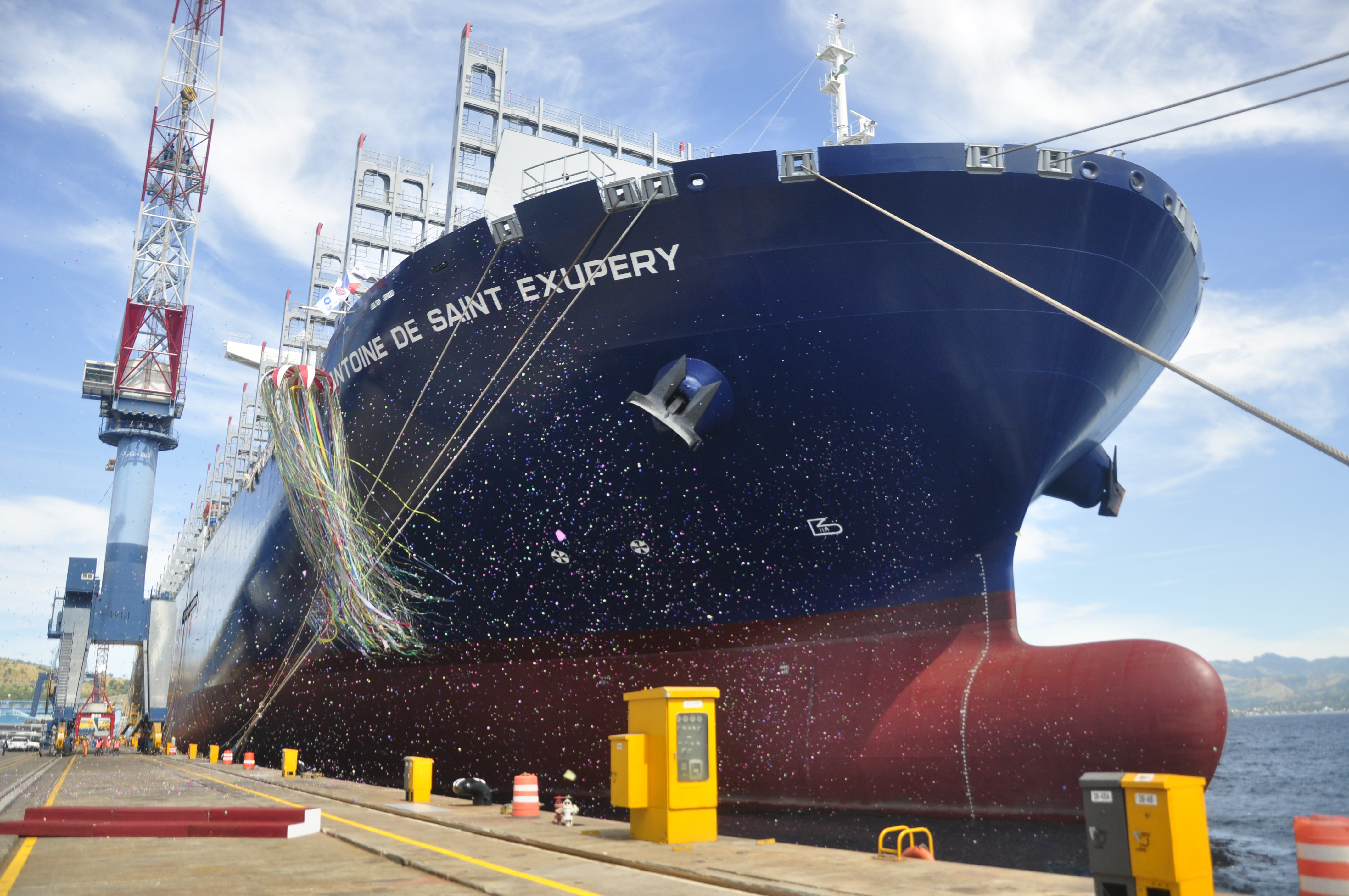
In January last year, as Hanjin delivered the CMA CGM Antoine de Saint Exupery, the first Subic-made 20,600 TEU-class container vessel, then HHIC-Phil President Gwang Suk Chung said the new vessel represented a breakthrough in global shipbuilding.
“This newly-built 20,600-TEU vessel proves, among others, the strength and capability of our Subic shipyard to manufacture in a timely manner mega-ships of much higher quality tonnage that are now shaping the shipping landscape around the world,” Chung said.
Cause and Effect
Hanjin’s fall appears to follow the path that has waylaid some of the Korea’s top shipbuilders since 2010.
In a report by the Korean news agency Yonhap in May 2016, it was said that heavy-tail contracts, whereby the buyer makes a larger payment late in the building process, may have resulted to heavy borrowings by Hyundai Heavy Industries, Samsung Heavy Industries and Daewoo Shipbuilding & Marine Engineering.
Pyong Jong Yu, HHIC-Phil’s executive director for administration, was said to have confirmed as much during a meeting with Eisma on Saturday when he said that Hanjin has agreed to heavy-tail payments.
A source said Yu revealed that the Subic shipbuilder has incurred at least $100 million losses because of stiff global competition, low prices of ships, and low production at the local shipyard.
Yu reportedly said that Hanjin’s troubles “drastically developed in October 2018, when we applied for loan for two ships (and) we were turned down.”
“We invested a lot of money when the shipbuilding industry was already at its peak,” Yu reportedly lamented. “Then it came down.”

Fallout
In a statement on Wednesday, SBMA Chairman Wilma T. Eisma said she was informed that Hanjin owes some $400 million in outstanding loans from Philippine banks on top of another $900 million in debts with lenders in South Korea.
The company still has six pending multi-million newbuilding projects at its Redondo Peninsula shipyard here, and that these may have to be cancelled if a rehabilitation plan does not materialize, Eisma also said.
“The bottom line is that the company said it does not have enough cash to repay its loans, and that it cannot continue with its operations under these circumstances,” Eisma added.
Eisma also said that in face of recent liquidity problem, Hanjin has laid off more than 7,000 workers last December and is poised to lay off another 3,000 early this year. The plan is to retain just about 300 local workers and as few as seven Korean supervisors by March to do facility maintenance, she added.
“The SBMA, of course, expressed its concern about the separation of shipyard workers, but we received assurances that those who were laid off were amply compensated. Still, we’re having this aspect checked out,” Eisma said.
White Knight
According to sources, Hanjin’s best scenario would be when the local creditor banks agree to the firm’s rehabilitation plan, which may involve the conversion of its debt to equity.
The worst would be when the court would tell Hanjin to liquidate its assets outright.
Eisma said the SBMA is now working with Hanjin officials to find some way to keep the shipbuilder, which has helped build Subic’s huge reputation in the global maritime industry.
“I really hope that Hanin’s creditors would agree to some rehabilitation plan, or that the company would find some financial partner to continue with its shipbuilding operations in Subic,” Eisma also said.
Specifically, Hanjin would need a white knight, a friendly party that would come to the aid of the ailing giant.
Hanjin had reportedly talked to various parties but had not made any real progress on negotiations. That could spell disaster for Subic’s biggest business operator, as well as the local economy.


Leave a comment