
By HENRY EMPEÑO
SAN ANTONIO, Zambales — The Philippine Navy (PN )received on Tuesday its first surveillance dirigible, a lighter-than-air craft that will be used as a radar platform to bolster government capacity in monitoring the country’s maritime domain.
The equipment was deployed at the Leovigildo Gantioqui Naval Station in this town, which hosts the Naval Education and Training Command (NETC).
The 28M-class Tethered Aerostat Radar System (TARS) was formally turned over by Col. Ernest C. Lee, chief of the Joint U.S. Military Assistance Group in the Philippines, in the presence of US Embassy deputy chief of mission to the Philippines Michael Klescheski. Vice Admiral Ronald Joseph Mercado, the Philippine Navy’s flag officer in command, received the equipment on behalf of the Philippine government.
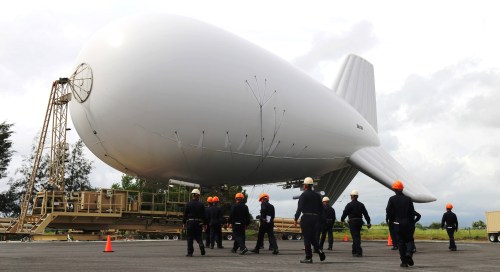
The Naval Public Affairs Office (NPAO) said the equipment handover was part of the US Maritime Security Initiative (MSI) Program for 2016-2020, a capacity-building assistance package of the US government for Southeast Asian countries that aims to improve the ability of these countries to address maritime challenges.
“Through this acquisition, the PN is poised to enhance its capability in maritime intelligence surveillance reconnaissance by effectively detecting maritime traffic within the country’s coastal waters,” said Capt. Lued Lincuna, who is NPAO director.
“Moreover, it will also be utilized in the conduct of humanitarian assistance and disaster response operations,” Lincuna added, pointing out that the TARS also includes a weather station that provides telemetry data to the ground station.
The system reportedly relays inputs like ambient temperature, pressure, wind speed, and other data to the monitoring station.
The TARS, which is described as a low-level airborne ground surveillance system that uses aerostats or moored balloons as radar platforms, is essentially a large fabric envelope filled with helium which gives it buoyancy.
While tethered by a single cable, it can rise up to an altitude of 15,000 feet and lift some 1,000 kilograms of payload to an operating altitude where it can provide low-level, downward-looking radar coverage of sea surface, ground, and low-level aerial activities.
The system reportedly uses the American-made TCOM 28M Operational Class Aerostat System, which has medium-range detection and monitoring capability and very similar to the TARS used by the US Department of Homeland Security for border surveillance.
Lincuna said the 28M-class tethered aerostat is specifically a “self-sustained, rapidly deployable, unmanned lighter-than-air platform.”
He added that the NETC compound was chosen as the deployment site because it can provide the minimum space of 300×300 feet open area required for launching the equipment.
As the premier naval institution in the country, the NETC can also supply personnel who can be trained to use the system, Lincuna added.
According to security forum MaxDefense Philippines, which has monitored the deployment of the TARS since last year, the aerostat’s radar system can detect activities up to 90 miles at maximum operating height. The surveillance aerostat provides information to the ground station, which can direct intercepting assets (air or sea) to the target.
The TARS package, MaxDefense added, was allocated by the US government as military aid for the Philippines in 2015 under former Pres. Barack Obama.
The system reportedly uses the American-made TCOM 28M Operational Class Aerostat System, which has medium-range detection and monitoring capability and very similar to the TARS used by the US Department of Homeland Security for border surveillance.





Leave a comment